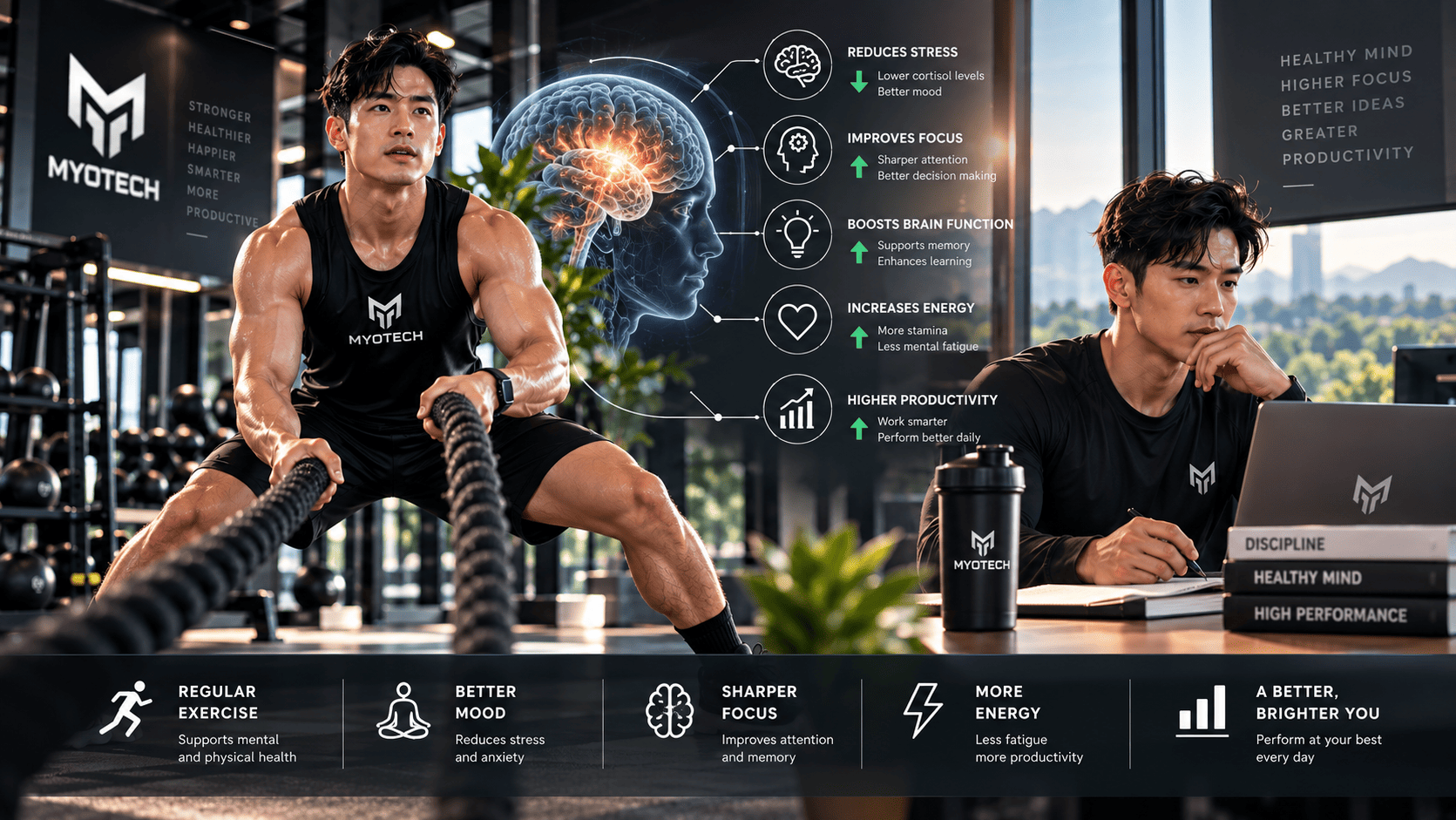
Modern life demands more from our minds than ever before.
Deadlines, meetings, business decisions, academic responsibilities, digital notifications, financial pressures, and constant access to information can make the brain feel as if it never truly switches off.
When this pressure accumulates, many people respond by sacrificing the very things that may help them function better—movement, exercise, sleep, and recovery.
We often think of fitness as something we do only for the body.
But regular physical activity can also support mental well-being, stress management, cognitive health, and our ability to function effectively in everyday life.
Training the body, therefore, is not necessarily time taken away from productivity.
It can be part of preparing ourselves to perform better.
Fitness Is More Than Building Muscle
When people hear the word fitness, they often imagine muscles, weight loss, running, or physical appearance.
Those are only parts of the picture.
During physical activity, multiple systems work together: the cardiovascular system, muscles, nervous system, metabolism, and brain.
This is one reason regular exercise is associated not only with physical fitness but also with psychological well-being.
A workout can create a temporary break from work-related demands while directing attention toward movement, breathing, coordination, and physical effort.
For some people, that transition can become an important part of managing daily stress.
Understanding Stress
Stress itself is not always harmful.
Short-term stress is a normal physiological response that helps us react to challenges.
The problem can arise when stress becomes persistent and opportunities for recovery become insufficient.
Prolonged psychological stress can influence mood, sleep, concentration, and general well-being.
Exercise does not eliminate the sources of stress in our lives.
It cannot remove deadlines, solve financial problems, or make difficult decisions disappear.
What it can do is become one component of a broader strategy for managing stress and maintaining health.
Exercise and Mental Well-Being
Physical activity has been associated with improvements in mood and reductions in symptoms of anxiety and depression across many populations.
Exercise can also provide something surprisingly valuable in an always-connected world:
focused time away from mental noise.
During training, attention shifts.
Instead of thinking continuously about emails, meetings, or unfinished work, we may focus on:
the next repetition,
our breathing,
our running pace,
our technique,
or simply completing the session.
That mental transition can help create separation between periods of intense cognitive work and recovery.
A Fit Body Can Support an Active Brain
The brain requires a continuous supply of oxygen and nutrients delivered through the circulatory system.
Regular physical activity supports cardiovascular health, and research has also linked exercise with aspects of cognitive function.
This does not mean that completing one workout will suddenly make someone smarter.
Cognitive performance is influenced by many factors, including sleep, nutrition, age, health status, stress, education, environment, and individual differences.
But regular physical activity can form part of a lifestyle that supports brain health.
Movement Can Help Break Mental Fatigue
Consider working at a computer for several hours without meaningful movement.
Attention may begin to drift.
The body becomes stiff.
Mental fatigue builds.
Instead of automatically reaching for another cup of coffee, sometimes a short period of movement can provide a useful change of state.
Walking, stretching, or performing a brief exercise session gives the body and mind a different task.
The goal is not to turn every work break into an intense workout.
Sometimes simply moving is enough to interrupt prolonged sitting and mental monotony.
Productivity Is Not About Working Every Minute
There is an important misconception about productivity:
The more hours we work, the more productive we become.
Human performance does not work that simply.
Being present at a desk for ten hours does not necessarily mean producing ten hours of high-quality thinking.
Productivity also depends on attention, energy, decision-making, motivation, and the ability to recover.
That means exercise should not automatically be viewed as time lost from work.
For many people, protecting time for physical activity can become part of a sustainable performance routine.
Fitness Can Create Structure
Regular exercise also introduces structure into daily life.
A person who schedules training may begin organizing their day around specific periods for:
Work → Training → Nutrition → Recovery → Sleep
That structure can encourage greater awareness of time and daily habits.
Exercise itself does not magically create discipline in every area of life, but maintaining a training routine requires behaviors that are transferable:
showing up, following a plan, managing time, tolerating gradual progress, and repeating useful actions consistently.
These qualities can also be valuable outside the gym.
Strength Training and Mental Focus
Resistance training requires concentration.
When performing movements such as squats, presses, rows, or other exercises, we need to pay attention to technique, body position, breathing, load, and repetitions.
For that period of time, attention becomes focused on the immediate task.
This is one reason training can feel mentally different from passive rest.
The mind is still active—but it is focused on something other than work-related demands.
For some people, this creates a useful psychological transition between professional responsibilities and personal recovery.
Cardio Can Play a Different Role
Aerobic exercise offers another experience.
Walking, cycling, swimming, jogging, and similar activities can involve repetitive rhythmic movement.
Depending on intensity and personal preference, these activities may provide space to think, decompress, or simply focus on movement.
There is no requirement to choose between resistance training and cardiovascular exercise.
A balanced fitness routine can incorporate both.
Recovery Determines Sustainability
Exercise itself is a form of physical stress.
More exercise is therefore not automatically better.
If someone combines demanding work, insufficient sleep, inadequate nutrition, psychological stress, and excessive training, exercise may become another source of fatigue rather than a helpful part of their routine.
This is why fitness should always be accompanied by recovery.
Training + Nutrition + Sleep + Recovery
belong together.
A sustainable program considers the person’s total workload—not only what happens inside the gym.
Sleep Connects Fitness and Productivity
Sleep deserves particular attention.
When people become busy, sleep is often one of the first things sacrificed.
But insufficient sleep can affect attention, mood, reaction time, learning, and decision-making.
Exercise can support healthy sleep as part of an overall lifestyle, but it cannot compensate completely for chronically inadequate sleep.
Someone who wants sustainable productivity should therefore think beyond working harder.
The objective should be to create conditions that allow the brain and body to perform consistently.
Fitness as Part of Professional Performance
Imagine two definitions of professional performance.
The first is:
Work as much as possible.
The second is:
Maintain the physical and mental capacity required to perform high-quality work consistently.
The second perspective changes how we view health.
Exercise stops being something we do only when we have spare time.
It becomes part of maintaining the person responsible for doing the work.
For entrepreneurs, professionals, coaches, students, managers, and anyone whose work requires sustained concentration, maintaining physical fitness can therefore be viewed as an investment in personal capacity.
You Don’t Need Hours Every Day
A common barrier is:
“I don’t have time to exercise.”
But fitness does not require spending several hours in the gym every day.
The appropriate amount and type of activity depends on the individual.
A practical routine might combine structured exercise sessions with more movement throughout the day.
Walking between periods of work.
Taking the stairs.
Standing periodically.
Performing resistance training several times per week.
Including cardiovascular activity.
Taking active breaks.
The important objective is to make movement a repeatable part of life, rather than an occasional extreme effort.
Train for Life, Not Just Appearance
A strong physique can be rewarding.
Improved performance can be motivating.
But the value of fitness extends beyond what we see in the mirror.
Exercise can contribute to physical capacity.
Movement can provide a break from cognitive demands.
Training can create structure.
Fitness can support health.
And maintaining health can help us continue doing the things that matter to us—including our work.
The body and mind are not separate systems competing for our time.
They are parts of the same person.
Conclusion: A Healthy Mind Needs a Healthy Lifestyle
Productivity should not be measured only by how long we can continue working.
Sustainable productivity means having enough physical and mental capacity to think, create, decide, communicate, and perform consistently without continually neglecting recovery.
Regular exercise can be one important component of that foundation.
It will not eliminate every source of stress.
It will not solve every mental health problem.
And it cannot replace professional healthcare when it is needed.
But combined with adequate sleep, nutrition, recovery, social connection, and appropriate healthcare, regular physical activity can support both physical and mental well-being.
So when you schedule your next workout, don’t think of it only as training your muscles.
You may also be investing in the person who needs to make tomorrow’s decisions.
Train your body. Protect your mind. Build the capacity to perform.