Great coaching is built on more than delivering workouts.
A coach needs to understand the client, design an appropriate training program, monitor execution, record progress, evaluate results, communicate effectively, and continuously adjust the program as the client develops.
When a coach manages only one or two clients, much of this information may still be manageable manually.
But what happens when a coach handles 10, 20, 50, or even more clients?
Notes become scattered. Training programs are stored in different files. Progress photos are separated from measurements. Session histories are difficult to review. Messages disappear inside personal messaging applications.
This is where fitness coaching technology can make a meaningful difference.
The purpose of technology is not to replace the coach.
It is to give coaches better tools to coach.
Coaching Requires More Than a Workout Program
A training program is only one component of the coaching process.
Behind every client there is information that develops over time:
training history, goals, exercise selection, sets and repetitions, training frequency, session schedules, physical assessments, body measurements, performance data, progress photos, coach notes, and program adjustments.
Without an organized system, valuable information can become fragmented.
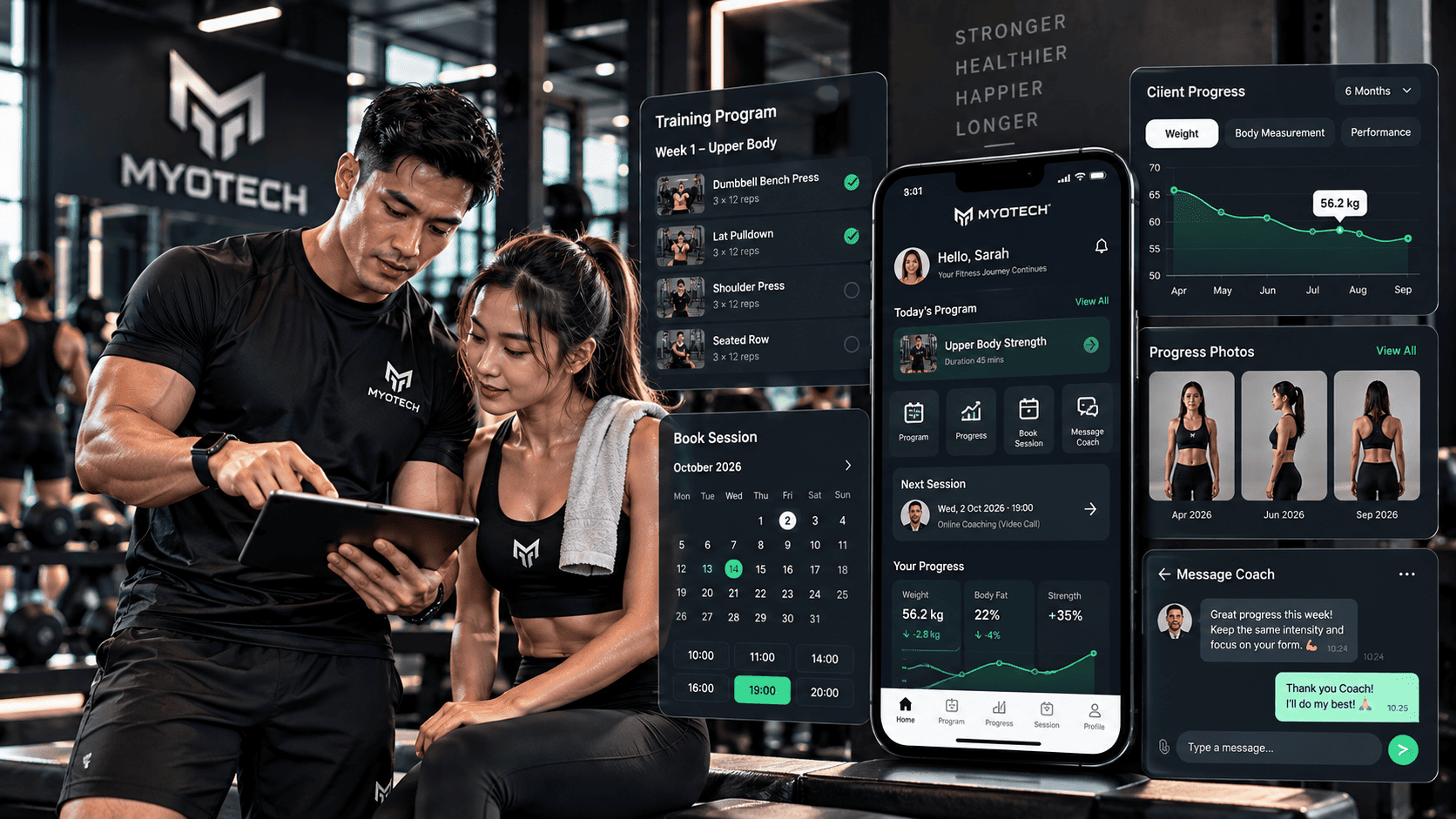
A digital coaching platform can bring these elements together into a single client record.
Instead of asking:
“Where did I save this client’s previous program?”
The coach should be able to open the client’s profile and immediately understand the journey.
One Client, One Coaching History
Imagine opening a client dashboard and seeing:
Client Profile → Assessment → Program → Sessions → Progress → Coach Notes → Communication
This creates something extremely valuable:
continuity.
The coach can see what the client was doing several weeks or months ago, what has changed, and how the current program relates to previous training.
Programs Become Easier to Manage
Instead of sending workout programs through screenshots, spreadsheets, PDFs, or scattered messages, coaches can create and update programs directly inside the platform.
A program might contain:
Exercise → Sets → Repetitions → Load → Rest → Tempo → Instructions
When changes are needed, the coach updates the program.
The client then sees the latest version from their own dashboard.
This reduces confusion about which program is currently active.
Progress Should Be Recorded, Not Remembered
Human memory is limited.
A coach may remember that a client has improved, but good coaching benefits from documentation.
Progress can involve much more than body weight.
Depending on the client’s goals, useful information may include:
- body measurements,
- training performance,
- repetitions,
- training load,
- mobility,
- exercise technique,
- attendance and consistency,
- progress photos,
- fitness assessments,
- subjective feedback.
When these records are stored over time, both coach and client can review the journey more clearly.
Data Helps Coaches Make Better Decisions
More data does not automatically mean better coaching.
The important question is whether the information helps the coach make a useful decision.
For example, if a client’s performance has improved consistently, the program may be ready to progress.
If performance declines while fatigue increases, the coach may need to reconsider training volume, intensity, recovery, or other relevant factors.
Technology can organize the information.
The coach still provides the interpretation.
This distinction is important.
Software should support professional judgment—not replace it.
From Generic Programs to Personalized Coaching
Two clients can have the same goal and still require different programs.
Consider two people who both want to become stronger.
One may be a beginner.
The other may have trained for five years.
One may train three times per week.
The other may have time for five sessions.
Their movement ability, exercise preferences, equipment access, lifestyle, and training history may also differ.
A digital coaching system makes it easier to maintain individualized programs without losing track of each client’s information.
This is where technology can support personalization at scale.
Communication Is Part of Coaching
A program alone cannot answer every question.
Clients may need to ask:
“Is my technique correct?”
“Can I replace this exercise?”
“I missed yesterday’s session. What should I do?”
“Should I increase the weight?”
Communication therefore needs to be connected to the coaching process.
Instead of mixing coaching conversations with unrelated personal messages, an integrated platform can provide dedicated communication between coach and client.
The conversation then becomes part of the coaching environment.
Booking Sessions Should Be Simple
Scheduling can become surprisingly complicated when a coach manages many clients.
Messages such as:
“Are you available tomorrow?”
“What about 7 PM?”
“Can we move it to Friday?”
can consume time that should be spent coaching.
A booking system allows clients to view appropriate availability and request or schedule sessions within the platform.
The result is a clearer workflow:
Choose Session → Select Schedule → Confirmation → Coaching Session → Session History
Online Coaching Expands the Coaching Relationship
Technology also removes some geographical limitations.
A coach and client no longer need to be in the same physical location for every interaction.
Programs can be delivered digitally.
Progress can be recorded remotely.
Questions can be discussed through chat.
Scheduled consultations can take place through video sessions.
This creates a coaching model where physical meetings and digital interactions can complement each other.
The Coach Should See the Whole Client Journey
A useful coaching dashboard should answer important questions quickly:
What program is the client currently following?
When was the last session?
What is the next session?
How has performance changed?
What progress has been recorded?
How many sessions remain?
What did the coach note during the previous evaluation?
Has the client sent a message?
When all of this information is connected, the coach gains a much clearer picture of the client journey.
Technology Should Reduce Administration, Not Add More
Technology only becomes useful when it simplifies work.
If coaches need five different applications to manage one client, the technology itself becomes another problem.
A better approach is integration.
Dashboard → Coach → Program → Chat → Booking → Video Session → Progress → Payment
One account.
One client record.
One coaching ecosystem.
This allows coaches to spend less time searching for information and more time doing what matters:
coaching people.
Building the Future of Digital Coaching
The future of fitness coaching is not simply about replacing paper with a screen.
It is about connecting the entire coaching process.
Training programs become living documents that can evolve.
Progress becomes a history that can be reviewed.
Sessions become organized records.
Communication becomes connected to the client.
And coaches gain tools that allow them to manage more information without losing personalization.
Technology will continue to evolve.
Artificial intelligence, wearable devices, connected fitness equipment, automated reporting, and advanced analytics may provide coaches with even more information in the future.
But the fundamental principle should remain the same:
Technology supports the coach. The coach supports the client.
Conclusion: Better Systems Can Enable Better Coaching
Great coaching will always require human qualities that software cannot simply replace:
knowledge, communication, observation, empathy, judgment, and the ability to understand another person’s needs.
But coaches also need good systems.
When programs, sessions, progress, communication, and client information are organized in one place, coaching can become more structured and easier to manage.
That is the opportunity created by modern fitness technology.
Not to remove the human relationship from coaching.
But to give that relationship a stronger digital foundation.
Smarter systems. Better organization. More connected coaching.