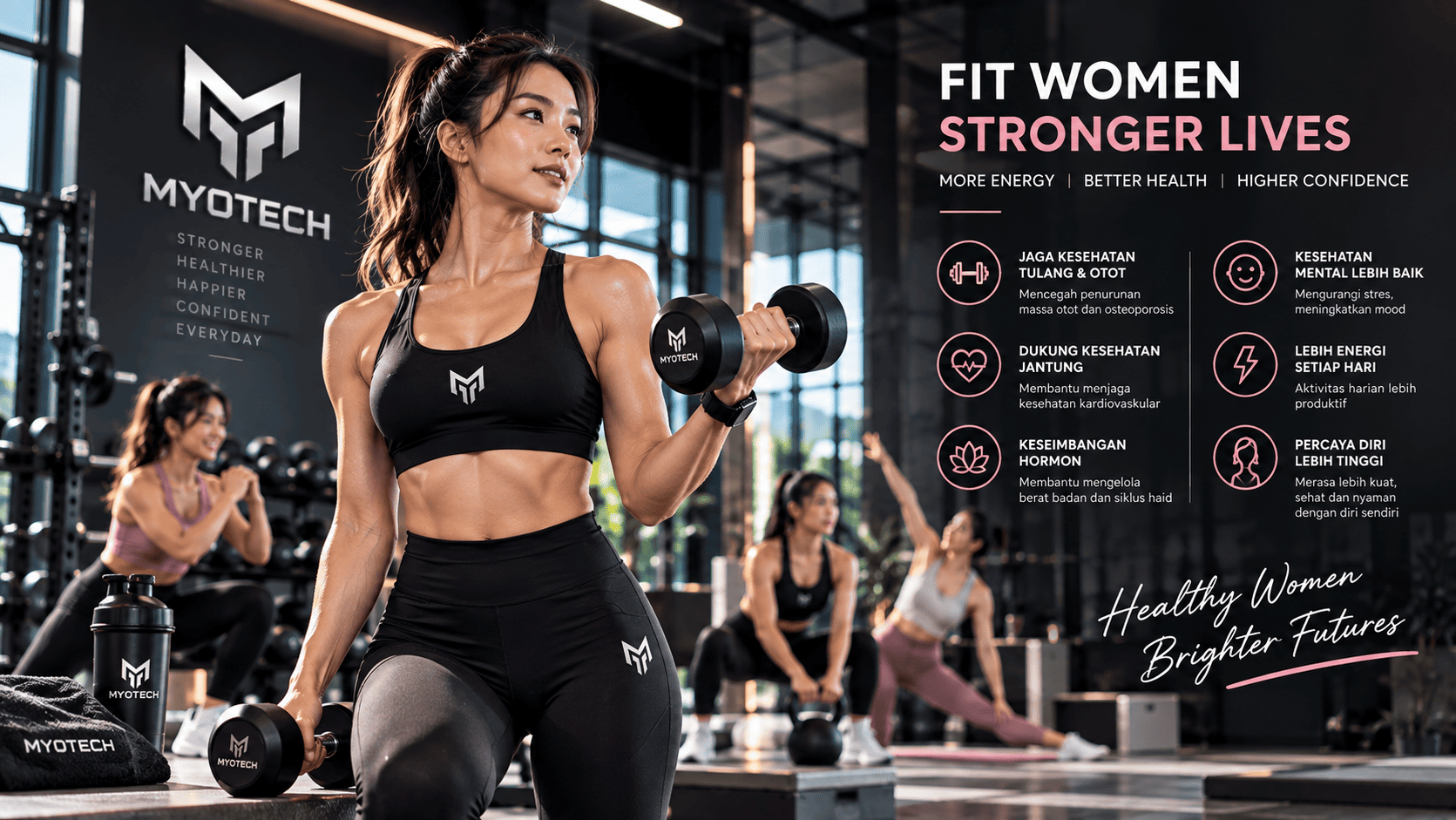
For many years, fitness for women has often been associated with one objective: losing weight.
Exercise programs are marketed around becoming smaller, burning calories, or achieving a particular body shape.
But women’s fitness deserves a much broader perspective.
Being physically fit means having the strength to perform everyday activities, cardiovascular capacity to remain active, strong muscles and bones, mobility to move confidently, and physical resilience that can support different stages of life.
From young adulthood to motherhood, professional life, menopause, and healthy aging, maintaining fitness can become one of the most valuable long-term investments a woman can make.
Fitness is not simply about changing how a woman looks. It is about strengthening what her body can do.
Women’s Fitness Is About Capability
A woman’s body performs countless physical tasks every day.
Walking.
Climbing stairs.
Working.
Carrying groceries.
Travelling.
Taking care of children.
Participating in sports.
And eventually maintaining independence as she grows older.
These activities require strength, endurance, balance, mobility, and coordination.
That is why fitness should not be viewed only through the mirror or the scale.
A better question is:
What is my body capable of doing?
Women Need Strength
One of the most persistent misconceptions in fitness is that strength training is primarily for men.
It isn’t.
Women also benefit from maintaining and developing muscular strength.
Resistance training can involve dumbbells, machines, resistance bands, bodyweight exercises, cables, free weights, and many other training methods.
The objective does not need to be bodybuilding.
Strength Has Practical Value
Stronger muscles can make everyday activities easier.
Squatting helps develop capacities involved in sitting and standing.
Rows and pulling movements develop the muscles involved in pulling and carrying.
Pressing movements develop upper-body strength.
Hip-dominant exercises can strengthen muscles important for locomotion and everyday movement.
Strength therefore has value far beyond the gym.
We train muscles so they can serve us outside the gym.
Muscle Becomes Increasingly Valuable with Age
Muscle mass and strength tend to decline with aging, particularly when physical activity is insufficient.
This makes maintaining muscle an important consideration for long-term physical function.
Women do not need to wait until older age to begin thinking about this.
Building an active lifestyle earlier provides an opportunity to enter later decades with a stronger physical foundation.
This changes the meaning of strength training.
It is no longer simply about today’s appearance.
It becomes part of preparing for tomorrow’s independence.
Fitness Supports Bone Health
Bone health is particularly important for women across the lifespan.
Bone mass changes with age, and the decline in estrogen associated with menopause can accelerate bone loss.
Weight-bearing physical activity and appropriately programmed resistance training can form part of a lifestyle that supports bone health.
Exercise cannot guarantee that someone will never develop osteoporosis, and individual risk is influenced by age, genetics, nutrition, hormonal status, medical conditions, medications, and other factors.
But physical activity is one modifiable component worth developing throughout life.
Cardiovascular Fitness Matters Just as Much
Strength is only one part of women’s fitness.
The cardiovascular system also needs regular activity.
Walking, running, cycling, swimming, dancing, group exercise, and other aerobic activities can help develop cardiovascular fitness.
Women therefore do not need to choose between:
Cardio OR strength training.
A balanced program can contain both.
Resistance training develops strength and muscular capacity.
Aerobic training develops endurance and cardiovascular fitness.
Mobility work supports movement.
Recovery allows adaptation.
Together, these components create a more complete approach to fitness.
Exercise and Mental Well-Being
Women often balance multiple responsibilities at once.
Career.
Education.
Family.
Relationships.
Parenting.
Social expectations.
Personal responsibilities.
The accumulation of these demands can contribute to stress and mental fatigue.
Exercise cannot remove every source of stress, nor should it be presented as a replacement for professional mental healthcare.
But regular physical activity can support psychological well-being and provide dedicated time to move, focus on the body, interact socially, or simply step away temporarily from daily demands.
For some women, the gym becomes more than a place to exercise.
It becomes personal time.
Fitness During Different Stages of Life
Women’s bodies and circumstances can change significantly across life.
That means training should also be adaptable.
Young Adulthood
This can be an excellent period to establish fundamental movement skills, develop strength, improve cardiovascular fitness, and build sustainable exercise habits.
The goal does not have to be perfection.
The important thing is learning how to train safely and consistently.
Pregnancy and Postpartum
Physical activity can remain valuable during pregnancy and after childbirth for many women, but individual circumstances differ.
Training may need to be modified according to pregnancy stage, symptoms, medical history, delivery, recovery, and professional medical guidance.
This is an area where individualized recommendations are particularly important.
Perimenopause and Menopause
As women approach and transition through menopause, changes in hormones can influence areas such as bone health, body composition, sleep, and other aspects of health.
Maintaining resistance training, cardiovascular activity, appropriate nutrition, and recovery can become especially valuable during this period.
Older Adulthood
Later in life, the objective may increasingly focus on maintaining:
strength, balance, mobility, endurance, and independence.
The numbers lifted in the gym become less important than what that strength allows someone to continue doing in everyday life.
Women Should Not Be Afraid of Lifting Weights
Another common concern is:
“If I lift weights, will I become too muscular?”
Significant muscular development requires appropriate training stimulus, nutrition, time, genetics, and consistency.
Resistance training does not automatically create an extreme bodybuilding physique.
For most women training for general health and fitness, strength training can instead be used to develop physical capacity, support muscle maintenance, and improve performance.
Weights are simply tools.
How they are programmed determines how they are used.
Fitness Should Not Become Punishment
Exercise should not exist solely to compensate for food.
A woman should not feel that she has to run because she ate dessert or train because she dislikes her body.
That relationship can turn physical activity into punishment.
A healthier perspective is:
I exercise because my body deserves to be cared for.
Training becomes an act of development rather than punishment.
The objective shifts from:
“I need to fix my body.”
to:
“I want to strengthen and take care of my body.”
That distinction matters.
Confidence Can Come from Capability
Physical confidence does not have to come only from appearance.
There is another form of confidence:
lifting something that once felt heavy.
Running farther than before.
Learning a new exercise.
Completing a challenging class.
Feeling stronger.
Moving without fear.
Seeing measurable improvement.
This is confidence built through capability.
And it can be one of the most rewarding outcomes of fitness.
Fitness Does Not Need to Look the Same for Every Woman
There is no single perfect form of exercise for women.
One woman may love strength training.
Another may prefer Pilates.
Another enjoys running.
Someone else chooses swimming, yoga, dance, cycling, functional training, or group classes.
The most appropriate program depends on goals, health, age, experience, preferences, available time, and physical condition.
Fitness should adapt to the woman.
The woman should not have to adapt her life to an unrealistic fitness ideal.
Strong Today, Independent Tomorrow
Perhaps one of the most important reasons for women to maintain fitness is something that may not become fully visible for decades.
Independence.
Having enough strength to get up from the floor.
Enough balance to reduce the likelihood of falls.
Enough endurance to travel.
Enough muscular capacity to perform everyday activities.
Enough confidence to continue moving.
We cannot control every aspect of aging or health.
But maintaining physical activity is one factor we can influence.
The workouts performed today are therefore not only about today’s body.
They can also be part of preparing for the woman we will become in the future.
Conclusion: Strong Women Build Stronger Futures
Women’s fitness should never be reduced to weight loss or appearance.
It is about building a body capable of supporting life.
Strong muscles.
Healthy movement.
Cardiovascular fitness.
Bone health.
Mobility.
Mental well-being.
Confidence.
And long-term independence.
Every woman’s journey will be different, and exercise should respect individual health, circumstances, and stages of life.
But the principle remains simple:
Taking care of physical fitness today is an investment in what your body may be capable of tomorrow.
Train not because you need to become smaller.
Train because you deserve to become stronger, healthier, more capable, and better prepared for the future.