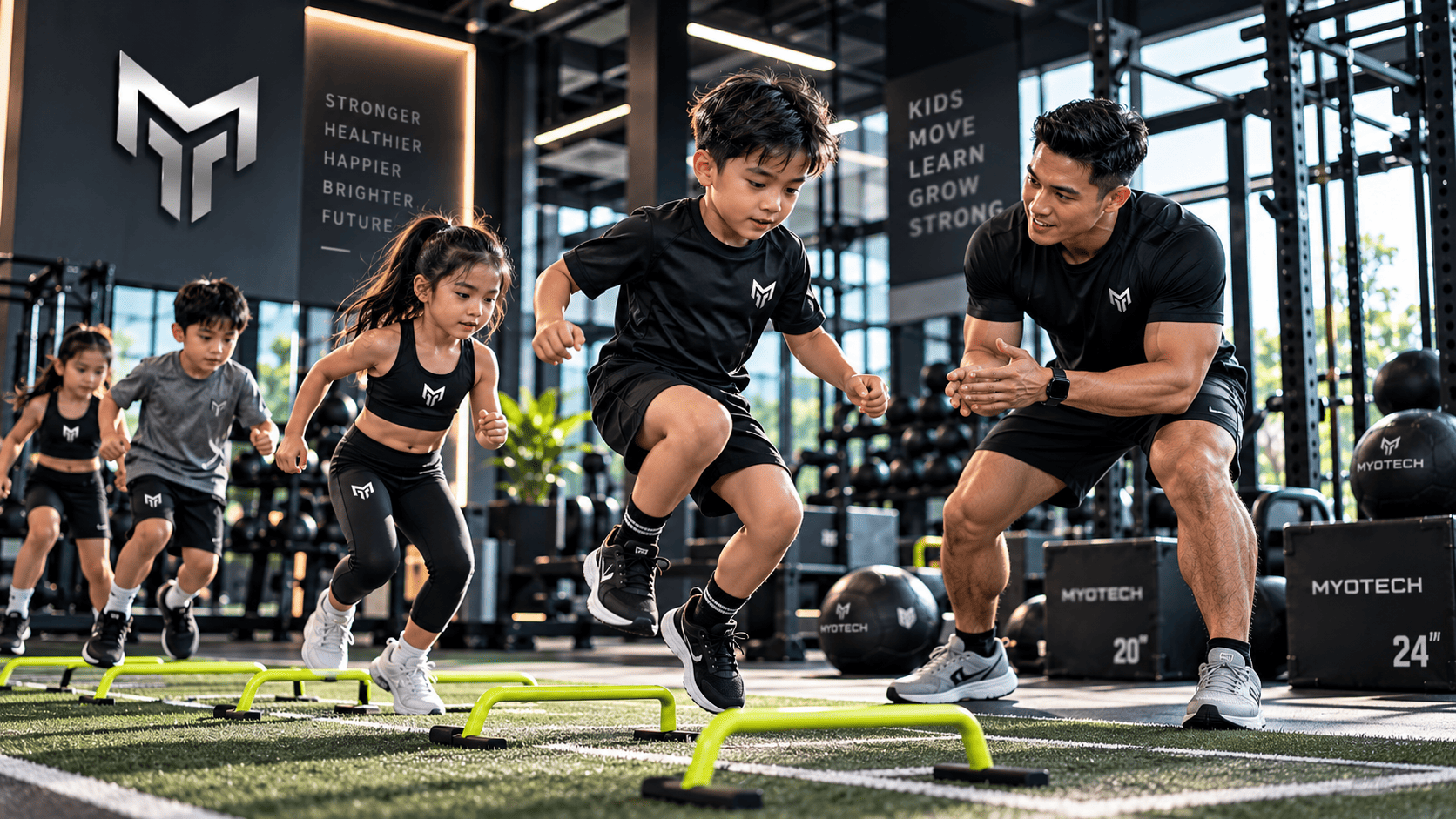
When we talk about preparing children for the future, we often think about education, knowledge, skills, and financial security.
But there is another foundation that is just as important: their health and physical fitness.
Children who learn to enjoy movement from an early age are not simply exercising for today. They are learning habits, movement skills, confidence, and an understanding of their bodies that can support an active lifestyle as they grow.
This is why fitness for kids should not be viewed as a trend or simply a smaller version of adult gym training.
It can be part of preventive health education—helping children understand from an early age that taking care of their bodies is an important part of taking care of their future.
Prevention Can Begin with Movement
Many conversations about health begin only after problems appear.
A better long-term approach is to also think about prevention.
For children, prevention does not mean worrying about diseases at a young age. It means creating an environment that makes healthy behaviors familiar and enjoyable.
Regular physical activity is one part of that environment.
The World Health Organization recommends that children and adolescents aged 5–17 accumulate an average of at least 60 minutes per day of moderate-to-vigorous physical activity across the week, with vigorous activities and activities that strengthen muscle and bone incorporated at least three days per week.
But these recommendations should not turn childhood into a rigid training schedule.
Children should still play, explore, run, jump, climb, learn and have fun.
Kids Fitness Is Not Adult Fitness
Children are not miniature adults.
Their bodies, movement abilities, attention spans, motivations, and developmental needs are different.
A good children’s fitness program therefore should not focus on bodybuilding, maximal lifting, appearance, or pushing children to exhaustion.
The Foundation Is Movement
Age-appropriate programs can introduce fundamental movement skills such as:
- running and changing direction,
- jumping and landing,
- balancing,
- throwing and catching,
- crawling and climbing,
- pushing and pulling,
- squatting and hinging,
- coordination and body control.
These skills can later become a foundation for sports, recreational activities, and everyday movement.
The objective is not to create young athletes as quickly as possible.
The objective is to help children become confident movers.
Strength Training Can Be Age-Appropriate
There is sometimes concern that children should never perform resistance or strength exercises.
The reality is more nuanced.
Appropriately designed and supervised resistance training can be part of youth physical activity. The emphasis should be on appropriate technique, progression, supervision, and exercises suited to the child’s developmental level.
Resistance can come from many sources—not just heavy barbells.
Bodyweight exercises, resistance bands, medicine balls, light external resistance, climbing, carrying, jumping, and playful movement challenges can all be incorporated depending on the child’s age and ability.
For children, quality of movement comes before the amount of weight.
Fitness Helps Children Discover What Their Bodies Can Do
Modern fitness culture can sometimes focus too heavily on appearance.
Children should receive a different message.
Exercise should teach them to appreciate what their bodies can do, rather than encouraging them to worry about how their bodies look.
Can I run?
Can I jump?
Can I balance?
Can I learn a new movement?
Can I become stronger?
Can I play longer?
Can I work together with my friends?
This creates a healthier relationship with physical activity.
Fitness becomes associated with ability, enjoyment, learning and confidence rather than punishment or appearance.
Building Healthy Habits Before Adulthood
Habits are easier to understand when they become part of everyday life.
A child who grows up seeing movement as normal does not have to suddenly discover physical activity as an adult.
They already understand that moving their body is part of life.
The same principle can apply to other behaviors surrounding health:
being active, eating a varied diet, drinking enough water, sleeping adequately, recovering, maintaining hygiene, and understanding when the body needs rest.
Fitness therefore becomes more than an exercise session.
It becomes health education through experience.
Parents and Coaches Shape the Experience
Adults have an important role in determining how children perceive exercise.
If physical activity is constantly associated with punishment, comparison, criticism, or pressure, children may develop negative feelings toward it.
But when movement is associated with discovery, encouragement, achievement, friendship, and fun, the experience can be very different.
Parents and coaches should focus on progress rather than perfection.
Not every child needs to be the fastest.
Not every child needs to be the strongest.
And not every child needs to become an athlete.
Every child, however, can be given opportunities to move, learn and develop.
Fitness Can Also Build Social Skills
Children’s fitness does not have to happen alone.
Group activities can provide opportunities to communicate, cooperate, follow instructions, solve movement challenges, take turns, and support teammates.
A well-designed class can therefore combine physical activity with social interaction.
The goal is not constant competition.
Sometimes children should compete.
Sometimes they should collaborate.
Sometimes they should simply play.
A positive environment allows all three.
Technology Has Changed Childhood
Today’s children are growing up surrounded by smartphones, tablets, gaming, streaming platforms, and digital entertainment.
Technology itself is not the enemy.
It can support education, creativity, communication, and even physical activity.
The challenge is balance.
When sedentary screen-based activities increasingly replace opportunities for active play and movement, children may simply spend less time moving.
Rather than framing the solution as technology versus exercise, families can create routines where both have appropriate places.
Digital literacy prepares children for the modern world.
Physical literacy prepares their bodies to live in it.
A Healthy Future Is Built Before We Need It
Parents invest in schools because education prepares children intellectually for the future.
We teach financial responsibility because it prepares them economically.
We teach values because they influence character.
Physical health deserves similar attention.
Teaching children to move, exercise, recover, and understand their bodies is another form of preparation.
We cannot guarantee what a child’s health will look like decades from now. Genetics, environment, socioeconomic circumstances, medical conditions, and many other factors will influence their health throughout life.
But we can give them something valuable today:
knowledge, opportunity, movement skills, and healthier habits.
The Goal Is Not Just a Fit Child. It Is a Health-Conscious Adult.
The greatest success of a children’s fitness program may not be visible immediately.
It may appear years later.
When that child becomes a teenager who enjoys being active.
An adult who understands the importance of exercise.
A parent who introduces movement to their own children.
Or an older adult who still considers physical activity a normal part of life.
That is why fitness for kids can be viewed as a long-term preventive investment.
We are not simply preparing children to perform better today.
We are helping prepare them to take responsibility for their health tomorrow.
Health & Fitness Disclaimer: This article is for educational purposes only. Children’s exercise programs should be age-appropriate and adapted to individual development, abilities, and health conditions. Children with medical conditions or specific health concerns should receive appropriate guidance from qualified healthcare professionals.